Outlook Calendar MCP server
The Outlook Calendar MCP server enables LLMs to read, interpret, and modify calendar data stored in Microsoft Outlook Calendar through natural conversation. It provides tools to retrieve events, check availability, and create, update, or delete calendar entries without requiring direct interaction with the Outlook interface.
Uses
Use the Outlook Calendar MCP server when you plan to perform the following actions:
- View upcoming or past calendar events for planning or reporting
- Check availability for yourself or other attendees to support scheduling
- Retrieve full details for specific events
- Schedule new meetings, focus time, or out-of-office events
- Reschedule, update, or cancel existing calendar events
- Access multiple calendars including shared and delegate calendars
- Find open time slots for meetings or personal time
- Manage recurring meetings and series
Example prompts
Use the following example prompts to invoke Outlook Calendar MCP server tools:
What's on my calendar for this week?Schedule a 30-minute meeting with Alex and Priya next Tuesday.When am I free tomorrow afternoon?Get the details for my 2pm meeting today.Move my standup meeting to 10am instead of 9am.Cancel the budget review meeting on Friday.What calendars do I have access to?Find a time when Sarah and I are both free this week.
Outlook Calendar MCP server tools
The Outlook Calendar MCP server provides the following tools:
| Tool | Description |
|---|---|
| list_events | Retrieves calendar events from one or more Outlook calendars within a time window you specify or by direction and count. |
| get_event | Retrieves full details for a single Outlook Calendar event by unique ID. |
| get_availability | Retrieves free or busy availability for the user and attendees over a time window you specify. |
| create_event | Creates a new Outlook Calendar event on a calendar the user is allowed to modify. |
| update_event | Updates an existing Outlook Calendar event with new details, including time, attendees, description, or recurrence. |
| delete_event | Deletes or cancels an existing Outlook Calendar event identified by its unique ID. |
| list_calendars | Retrieves the list of Outlook calendars accessible to the user. |
Install the Outlook Calendar MCP server
Complete the following steps to install a prebuilt MCP server to your project:
Sign in to your Workato account.
Go to AI Hub > MCP servers.
Click + Create MCP server.
Go to the Start with pre-built MCP Servers using your connected apps section and select the prebuilt MCP server you plan to use.
Click Use this server.
Provide a name for your MCP server in the Server name field.
Use the Location drop-down menu to select the project for the MCP server.
Go to the Connections section and connect to your app account.
Select the connection type you plan to use for the MCP server template.
- User's connection: MCP server tools perform actions based on the identity and permissions of the user who connects to the application. Users authenticate with their own credentials to execute the skill.
- Your connection: This option uses the connection established by the recipe builder and follows the same principles as normal app connections.
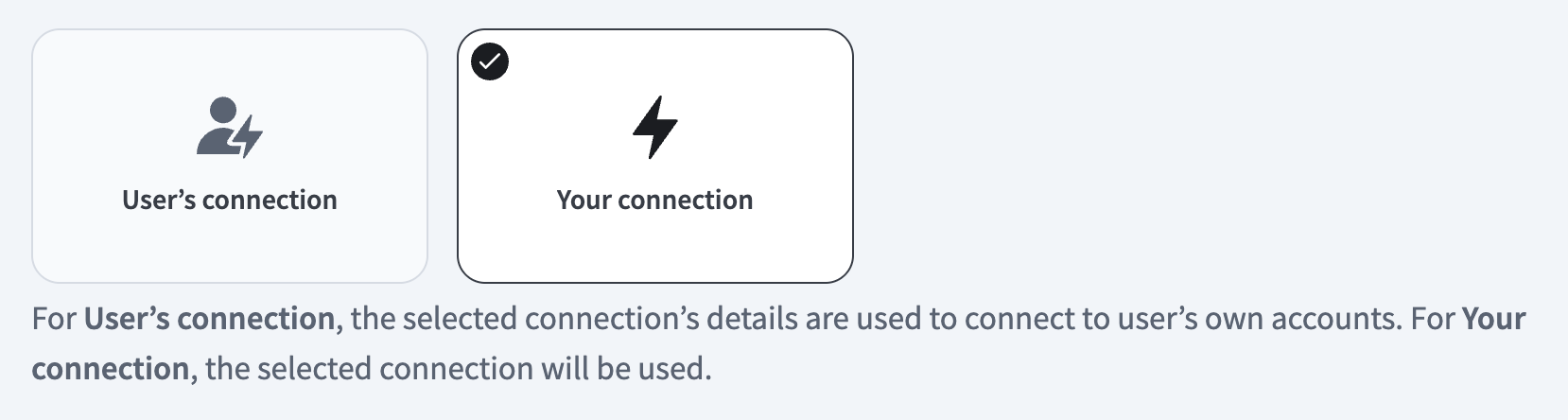 Select your connection type
VERIFIED USER ACCESS AUTHENTICATION REQUIREMENTS
Only app connections that use OAuth 2.0 authorization code grant are available for user's connection. Refer to Verified user access for more information.
Complete the app-specific connection setup steps in the following section.
Outlook Calendar connection setup
View Outlook Calendar connection setup steps
The Outlook connector supports the following authentication types:
- Authorization code grant authentication (OAuth 2.0)
- Client credentials-based authentication (OAuth 2.0): Only available for tenant-specific connections
MICROSOFT MFA ENFORCEMENT
Microsoft is rolling out mandatory multifactor authentication (MFA) gradually to different applications and accounts in phases. This enforcement continues throughout 2025 and beyond. Refer to the Microsoft Mandatory multifactor authentication for Azure and admin portals documentation for more information.
We strongly recommend enabling MFA now for all Microsoft accounts used with Workato to avoid service disruptions from short-notice enforcement changes.
Complete the following steps to maintain uninterrupted service:
Enable MFA for your Microsoft organization following the Microsoft MFA setup guide. Refer to Set up multifactor authentication for Microsoft 365 for more information.
Reconnect your Microsoft connection in Workato.
Complete the OAuth flow with MFA when prompted.
Test your recipes to ensure they work with the updated connection.
Authorization code grant authentication (OAuth 2.0)
View authorization code grant authentication steps
This authentication method requires the following value for tenant-specific account types:
- Tenant ID/Domain
Minimum and default scopes
View minimum and default scopes
The connector requests the following scopes for authorization code grant connections by default. These scopes are necessary to use all of the connector's triggers and actions. Additionally, you must assign these permissions to the Workato app as Delegated permissions in the Azure portal.
Mail.SendMail.ReadWriteMail.ReadWrite.SharedCalendars.ReadWriteCalendars.ReadWrite.SharedUser.Readoffline_access
The following minimum scopes are required to establish a connection to using authorization code grant authentication:
User.Readoffline_access
Outlook setup for authorization code grant authentication
Complete the following steps to set up Outlook for authorization code grant authentication:
- Register the Workato App in Azure portal
- Assign permissions to your app
- Obtain the Directory (tenant) ID from the Azure portal
Register the Workato app in the Azure portal
View register the Workato app in the Azure portal steps
Complete the following steps to register the Workato app in the Azure portal:
Sign in to the Azure portal.
Select App registrations > + New registration.
Enter a unique name for the application.
Use the Supported account types drop-down menu to select an account type.
Select Web from the Select a platform drop-down menu.
Use the following URI for the Redirect URI:
https://www.workato.com/oauth/callbackSelect Register.
Assign permissions to your app
View assign permissions to your app steps
Complete the following steps to assign permissions to your app:
Go to your newly registered app and select Manage > API permissions.
Click + Add a permission and select Microsoft Graph.
Add the required permissions as outlined in Minimum and default scopes. Depending on your connection type, you must assign Application or Delegated permissions.
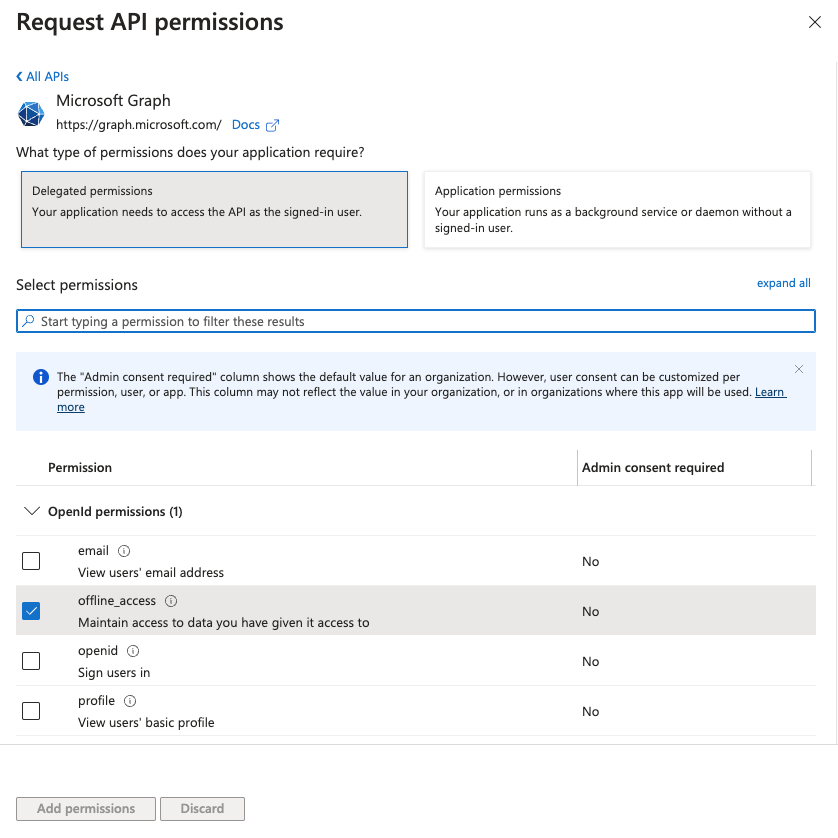 Add permissions
Click Add permissions.
Admin consent is required for specific permissions. Refer to Connect Microsoft Entra ID to the Outlook connector to learn more.
Obtain the Directory (tenant) ID from the Azure portal
View obtain the Directory (tenant) ID from the Azure portal steps
This step is required if you plan to use a tenant-specific account. You can skip this step if you plan to use a common, consumer, or organization account type for your connection.
Complete the following steps to obtain the Directory (tenant) ID from the Azure portal:
Go to the Overview > Essentials section.
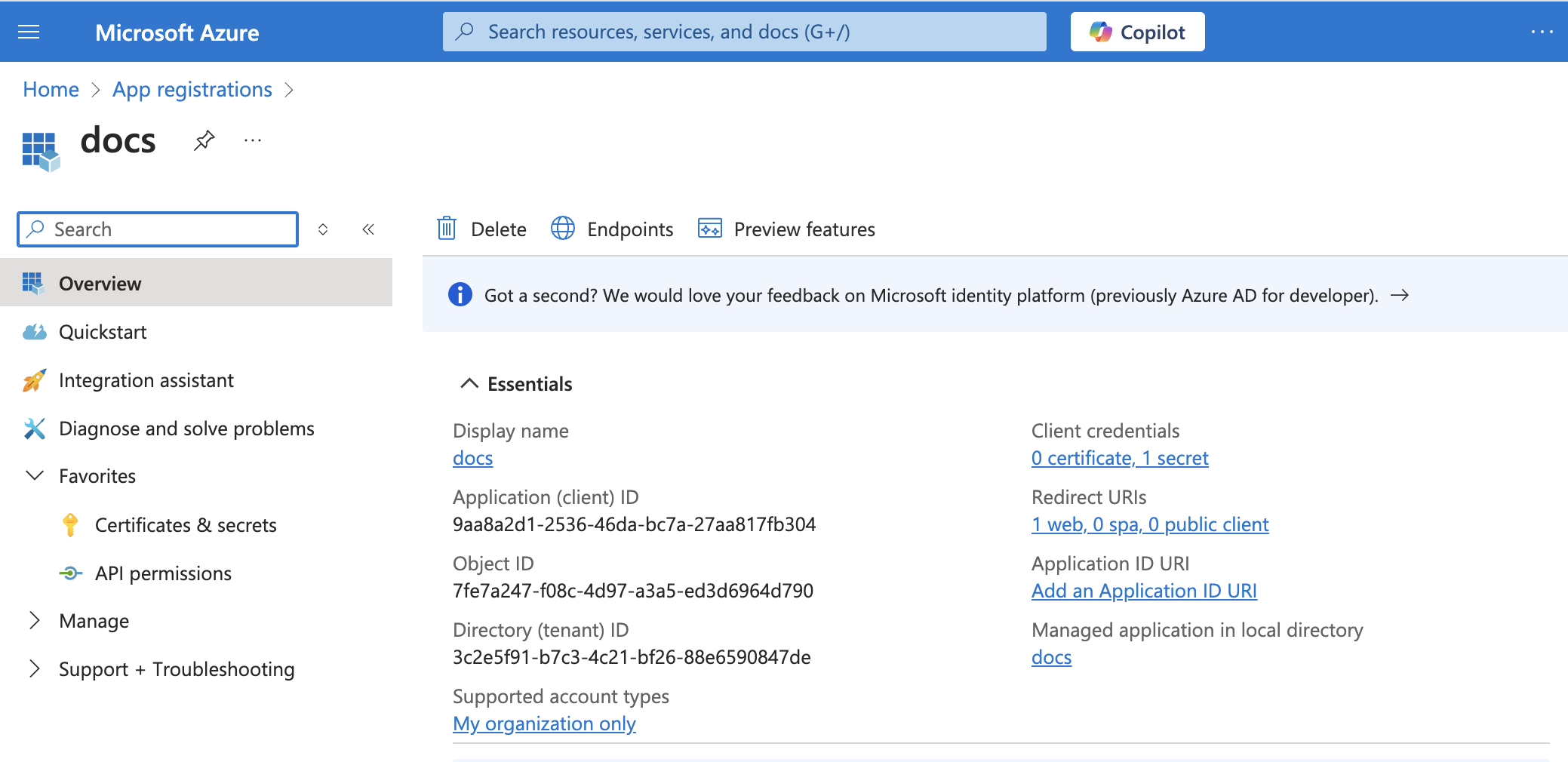 App details
Copy and save the Directory (tenant) ID for use in Workato.
Connect to Outlook with authorization code grant authentication
View connect to Outlook with authorization code grant authentication steps
Complete the following steps to set up an authorization code grant connection to Outlook in Workato:
Click Create > Connection or press C twice.
Search for Outlook and select it as your app.
Enter a name for your connection in the Connection name field.
Use the Location drop-down menu to select the project where you plan to store the connection.
Use the Connection account type drop-down menu to select the type of account you plan to use. The available choices are Common, Tenant-specific, Consumer, and Organization.
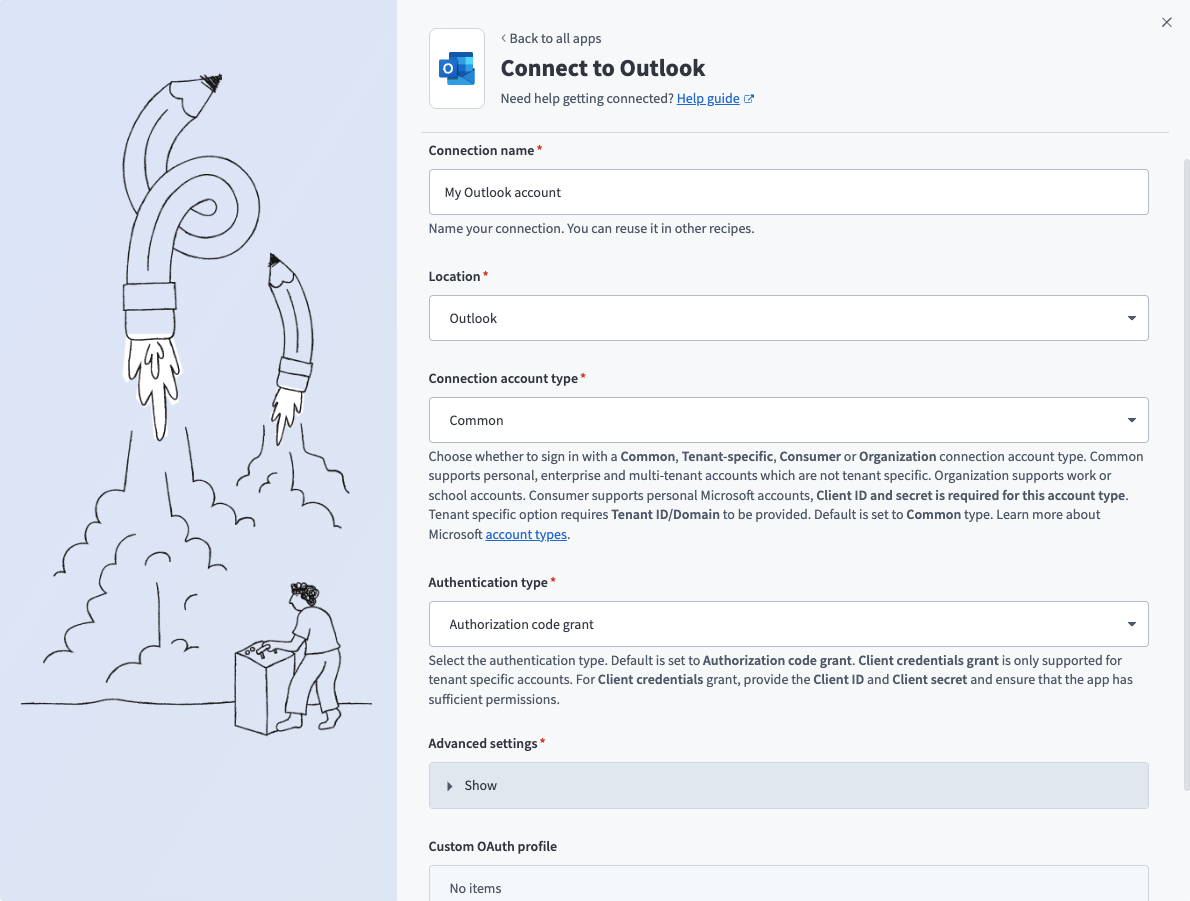 Common connections
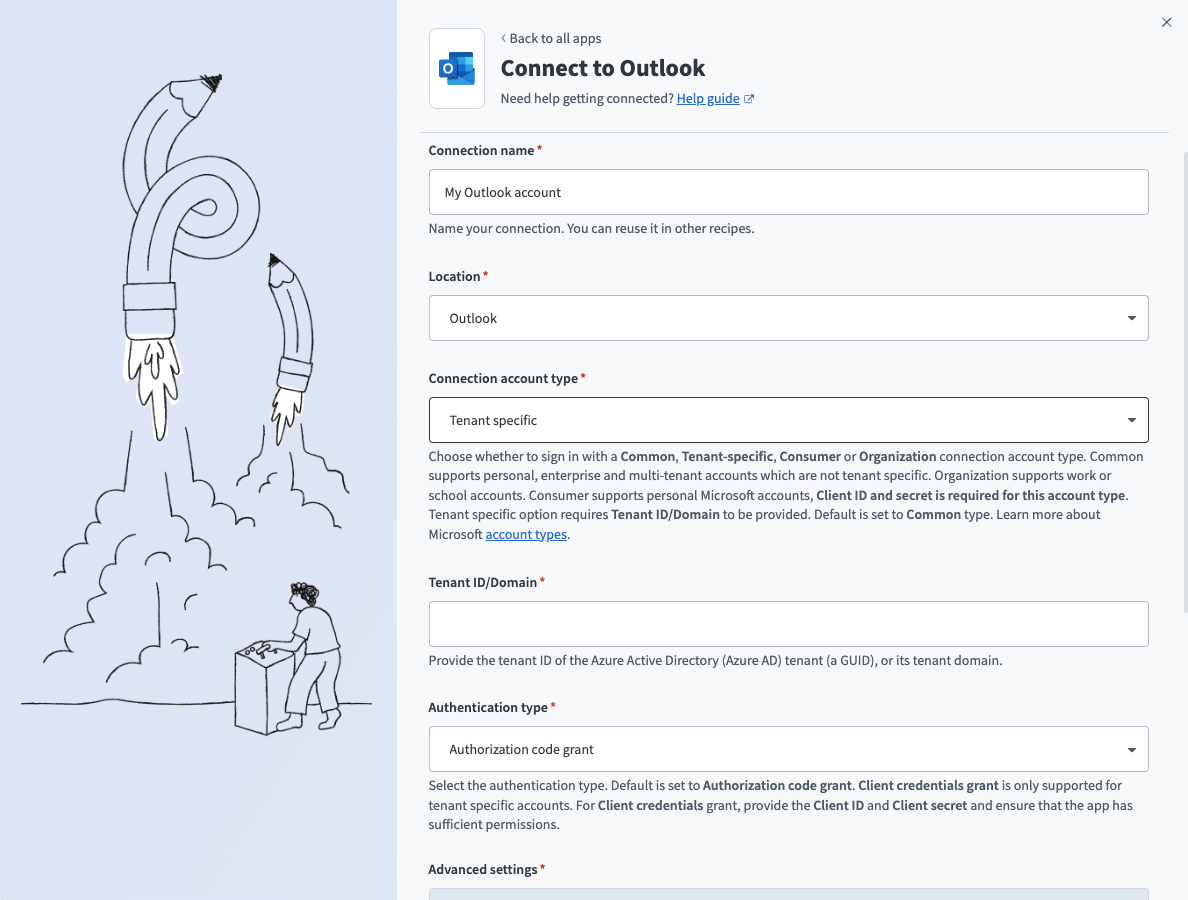 Tenant specific connections
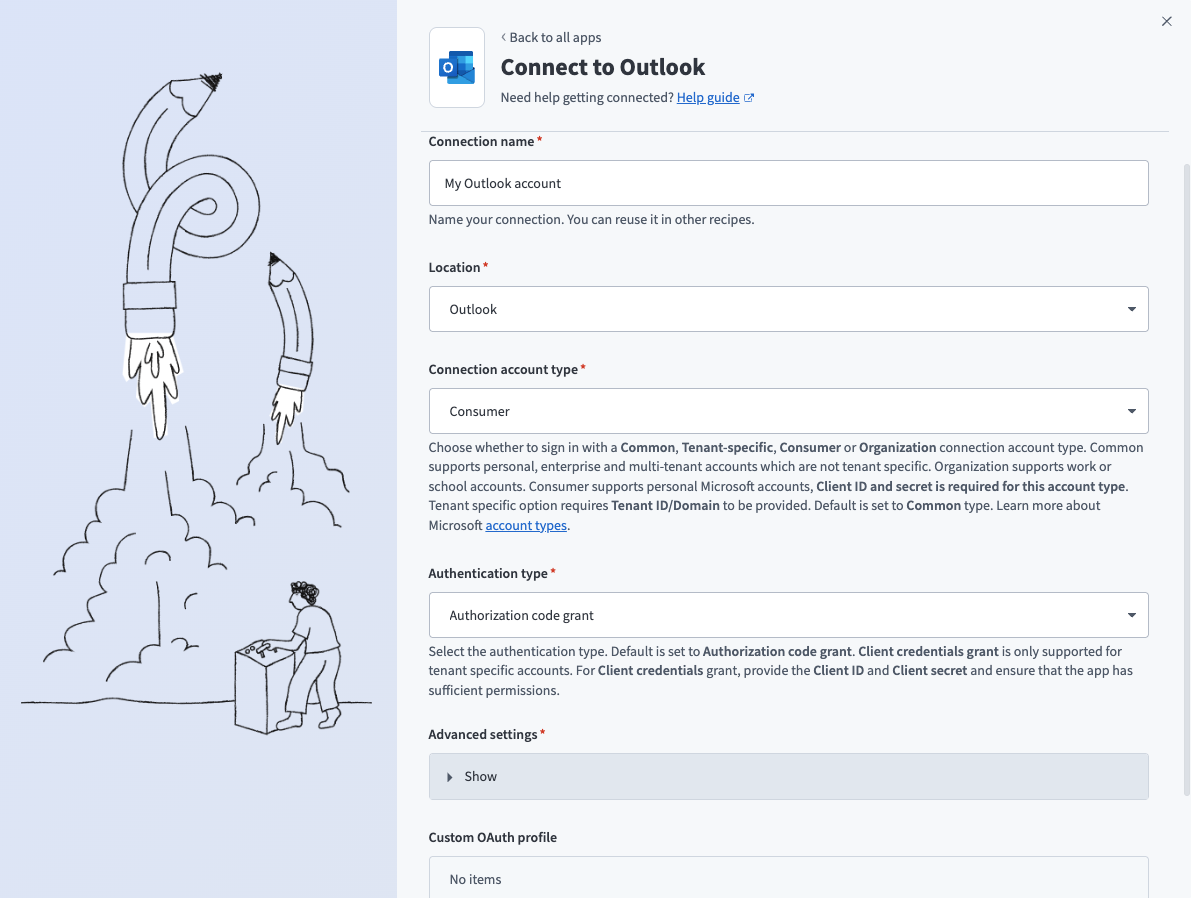 Consumer connections
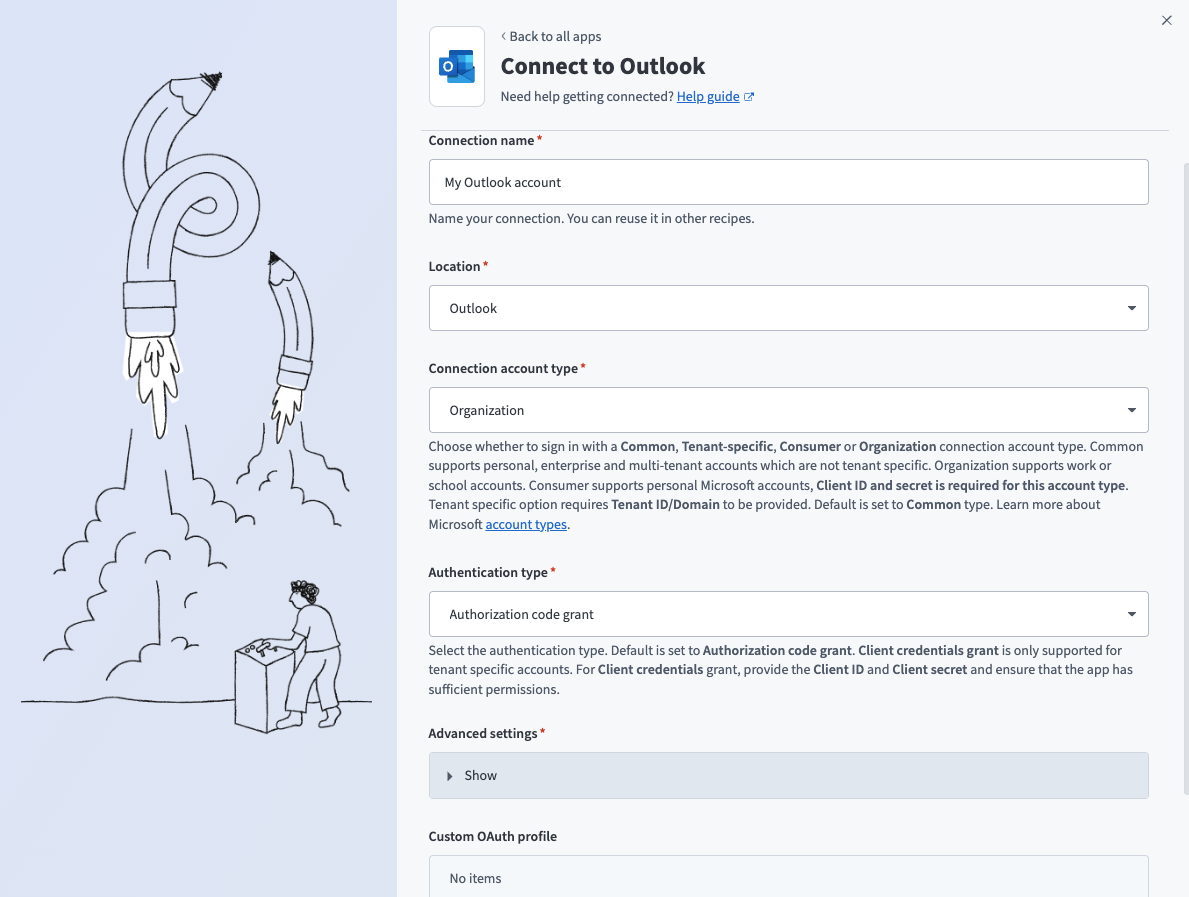 Organization connections
Use the Authentication type drop-down menu to select Authorization code grant.
Optional. The connector requests a set of scopes necessary for all triggers and actions to function properly by default. Go to the Advanced settings section to manually select the permissions instead. The minimum permissions required to establish a connection are User.Read and offline_access. Workato always requests these permissions regardless of the permissions you select. Refer to Minimum and default scopes for more information.
Optional. Use the Custom OAuth profile drop-down menu to select a custom OAuth profile for your connection. Refer to Outlook custom OAuth for more information.
Click Sign in with Microsoft.
Client credentials-based authentication (OAuth 2.0)
View client credentials-based authentication steps
This method requires the following fields:
- Tenant ID/Domain
- User ID
- Client ID
- Client Secret
COMPATIBLE AUTHENTICATION
Client credentials-based authentication is only compatible with tenant-specific connections.
Minimum and default scopes
View minimum and default scopes
We recommend the following scopes for client credentials connections. These scopes are necessary to use all of this connector's triggers and actions. Additionally, you must assign these permissions to the Workato app as Application permissions in the Azure portal.
Calendars.ReadCalendars.ReadWriteContacts.ReadContacts.ReadWriteMail.ReadMail.ReadWriteMail.Send
The following minimum scopes are required to establish a connection to with client credentials-based authentication:
Mail.Read
Outlook setup for client credentials-based authentication
Complete the following steps to set up Outlook for client credentials-based authentication:
- Register the Workato app in the Azure portal
- Assign permissions to your app
- Generate a client secret
- Obtain the Application (client) ID, Object ID, and Directory (tenant) ID from the Azure portal
- Obtain the User ID from the Azure portal
Register the Workato app in the Azure portal
View Register the Workato app in the Azure portal steps
Complete the following steps to register the Workato app in the Azure portal:
Sign in to the Azure portal.
Select App registrations > + New registration.
Enter a unique name for the application.
Use the Supported account types drop-down menu to select an account type.
Select Web from the Select a platform drop-down menu.
Use the following URI for the Redirect URI:
https://www.workato.com/oauth/callbackSelect Register.
Assign permissions to your app
View assign permissions to your app steps
Complete the following steps to assign permissions to your app:
Go to your newly registered app and select Manage > API permissions.
Click + Add a permission and select Microsoft Graph.
Add the required permissions as outlined in Minimum and default scopes. Depending on your connection type, you must assign Application or Delegated permissions.
Add permissions
Click Add permissions.
Admin consent is required for specific permissions. Refer to Connect Microsoft Entra ID to the Outlook connector to learn more.
Generate a client secret
View generate a client secret steps
Complete the following steps to generate a client secret:
Go to Manage > Certificates & Secrets > Client secrets.
Click + New client secret.
Provide a Description for the client secret and specify an Expires date.
Click Add.
Copy and save the client secret Value—not the Secret ID—for use in Workato.
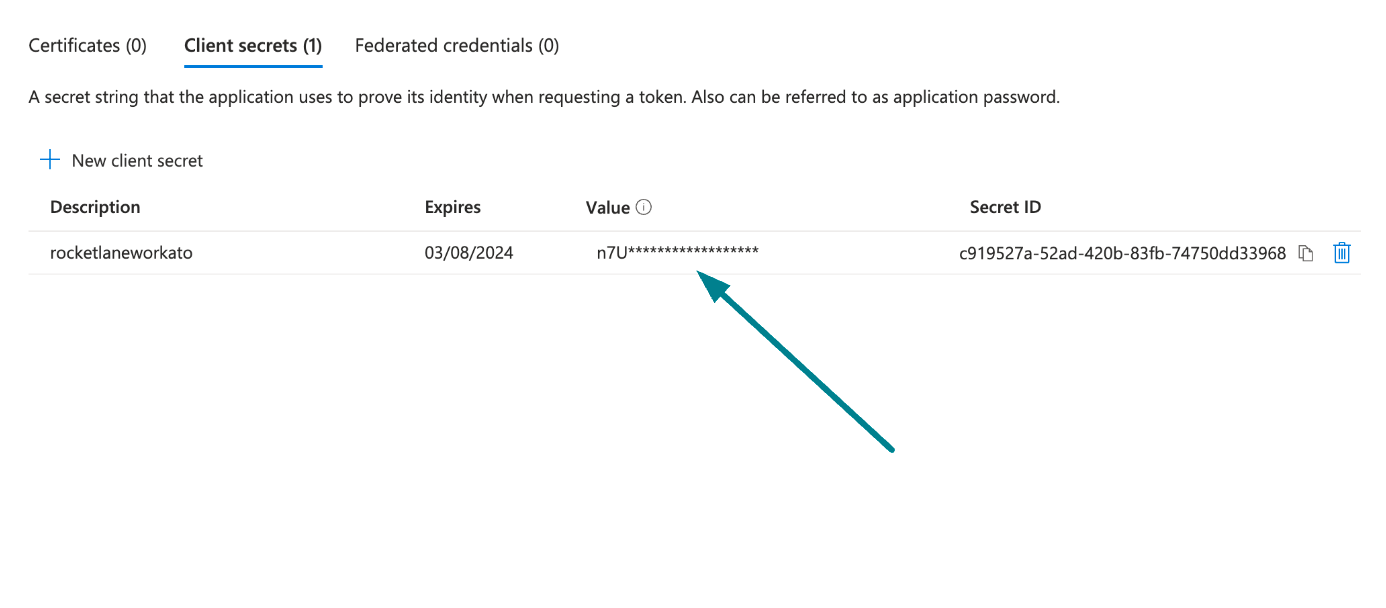 Copy and save the client secret value
Obtain the Application (client) ID, Object ID, and Directory (tenant) ID from the Azure portal
View obtain the Application (client) ID, Object ID, and Directory (tenant) ID from the Azure portal steps
Complete the following steps to obtain the Application ID, Object ID, and Directory (tenant) ID from the Azure portal:
Go to the Overview > Essentials section.
App details
Copy and save the Application (client) ID, Object ID, and Directory (tenant) ID for use in Workato.
Obtain the User ID from the Azure portal
View obtain the User ID from the Azure portal steps
Complete the following steps to obtain the User ID from the Azure portal:
Go to Home > Users to obtain the User ID.
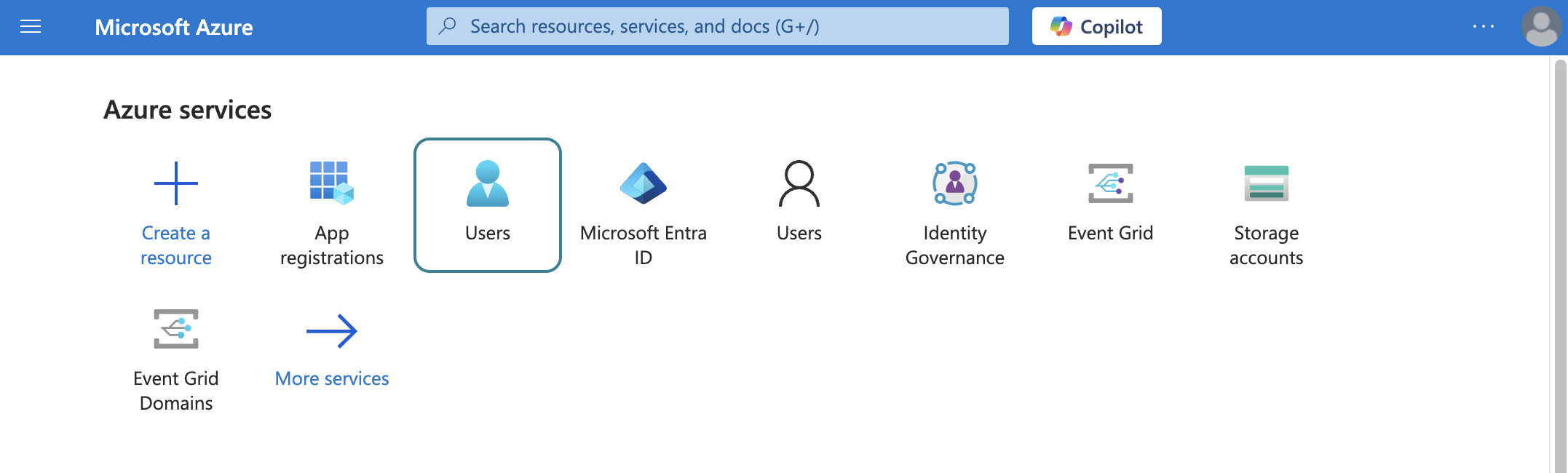 Select users
Search for and select the default user you plan to use to perform operations. This user doesn't establish the connection but is required for performing certain operations that an app can't perform. It's also required in picklists to pull user data. For example, the folder picklist populates folders belonging to the default user.
Copy and save the User principal name. Use this value as the User ID in Workato.
Connect to Outlook with client credentials-based authentication
View connect to Outlook with client credential-based authentication steps
Complete the following steps to set up a client credentials-based connection to Outlook in Workato:
Click Create > Connection or press C twice.
Search for Outlook and select it as your app.
Enter a name for your connection in the Connection name field.
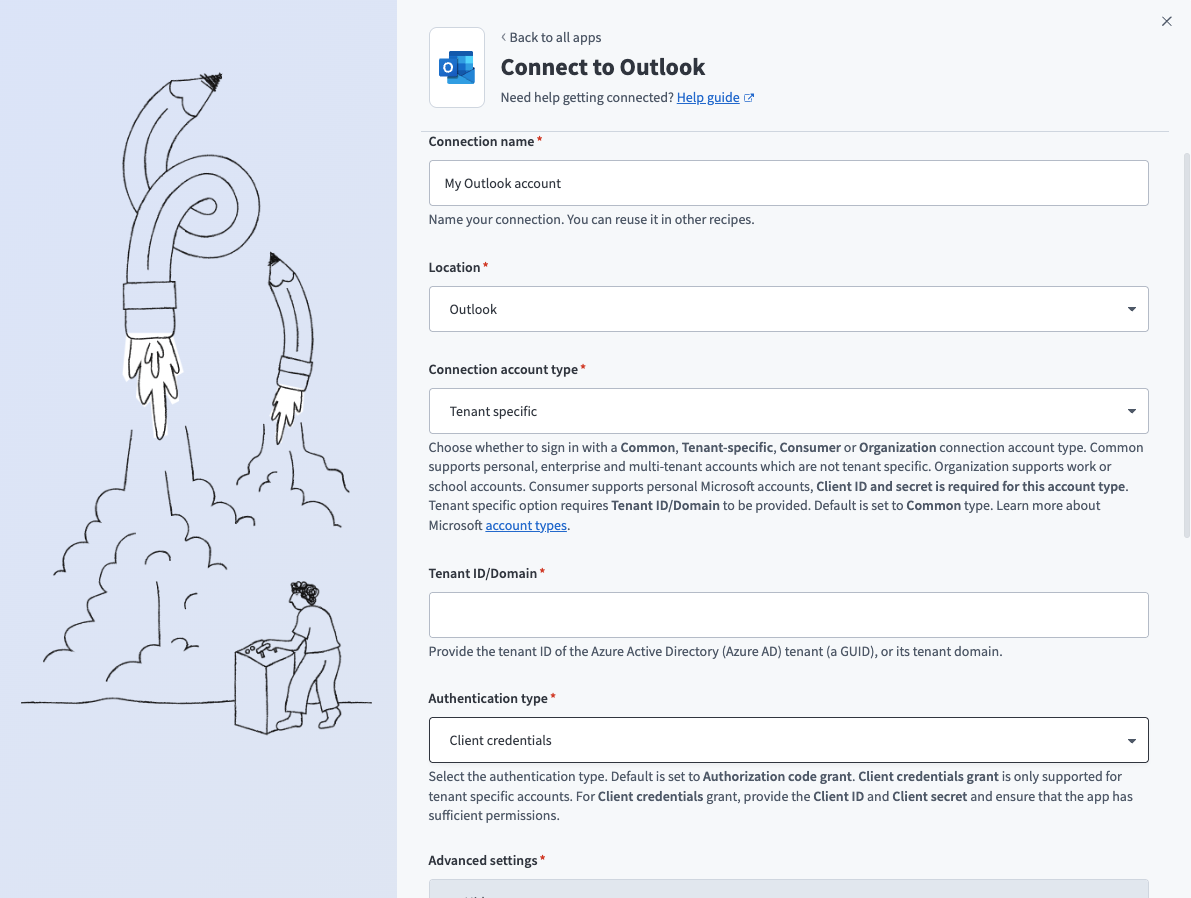 Client credentials connection
Use the Location drop-down menu to select the project where you plan to store the connection.
Select Tenant specific as the Connection account type. This option is specifically designed for users who belong to a particular organization (tenant).
Provide your Tenant ID/Domain. This is the Directory (tenant) ID for your app. Refer to Register an app in Azure for more information.
Use the Authentication type drop-down menu to select Client credentials.
Supply the User ID, Client ID, and Client secret for your app. Refer to Register an app in Azure for more information.
Click Sign in with Microsoft.
How to use Outlook Calendar MCP server tools
Refer to the following sections for detailed information on available tools:
list_events tool
The list_events tool retrieves calendar events from one or more Outlook calendars within a time window you specify or by direction and count. Your LLM uses this tool to see what's on your calendar, plan your day or week, or review past events.
Try asking:
What's on my calendar for this week?Show me my meetings for tomorrow.List all events on my calendar between January 1st and January 15th.What do I have scheduled for next Monday?
get_event tool
The get_event tool retrieves full details for a single Outlook Calendar event by its unique event ID. Your LLM uses this tool to read, inspect, or open a specific event, retrieve complete details before modifying or deleting the event, summarize a particular meeting, or confirm metadata prior to scheduling decisions.
Try asking:
Get the details for my 2pm meeting today.Show me the full information for the quarterly review meeting.What are the details of my next appointment?Read the agenda for the product planning meeting.
get_availability tool
The get_availability tool retrieves free and busy availability for you and attendees over a time window you specify. Your LLM uses this tool to find times to schedule a meeting, check whether you or others are free, evaluate potential windows for rescheduling, or identify open periods for PTO or focus time.
Try asking:
When am I free tomorrow afternoon?Find a time when Sarah and I are both free this week.Check my availability for Thursday between 2pm and 5pm.When are Alex, Mei, and I all available next week?
create_event tool
The create_event tool creates a new Outlook Calendar event. Your LLM uses this tool to schedule a new meeting or call, add a calendar hold or focus time block, create a recurring event, block off PTO or OOO time, or create follow-up meetings.
Try asking:
Schedule a 30-minute meeting with Marco and Jade next Tuesday at 2pm.Create a recurring weekly standup every Monday at 9am.Block off next Friday as PTO.Set up a focus time block for tomorrow morning from 9am to 11am.
update_event tool
The update_event tool updates an existing Outlook Calendar event with new details including time, attendees, description, or recurrence. Your LLM uses this tool to move or reschedule a meeting, shorten or extend an event's duration, add, remove, or update attendees, update meeting descriptions or agendas, or modify a recurring series.
Try asking:
Move my standup meeting to 10am instead of 9am.Reschedule the budget review to next Wednesday.Add Josh to the product planning meeting.Extend my 1pm meeting by 30 minutes.
delete_event tool
The delete_event tool deletes or cancels an existing Outlook Calendar event identified by its unique ID. Your LLM uses this tool to cancel meetings, remove calendar blocks, or delete events that are no longer needed.
Try asking:
Cancel the budget review meeting on Friday.Delete my 3pm appointment tomorrow.Remove the team lunch from my calendar.Cancel the recurring standup for next week only.
list_calendars tool
The list_calendars tool retrieves the list of Outlook calendars accessible to you, including default, secondary, shared, and delegate calendars. Your LLM uses this tool to discover available calendars, select a specific calendar for operations, or understand your calendar access.
Try asking:
What calendars do I have access to?Show me all my Outlook calendars.List the shared calendars I can view.What calendars are available for scheduling?
Getting started
View and manage your MCP server tools in the Overview page Tools section. Tool management provides the following capabilities:
TOOLS MUST BE STARTED
Your LLM can only access active tools in your MCP server connector.
Last updated: