# Conversations history
The Conversations page provides a complete view of your genie's interaction history, including a table of past conversation threads with key details such as:
- Conversation topic
- User who started the conversation
- Started at
- Last message at
- Started via
- Unique conversation ID
- Number of errors encountered
You can click a conversation to open the Conversation details panel. This lets you view the full exchange between the user and the genie. Each genie response in the thread is interactive. You can click a thread to open a Response details panel on the right, showing a breakdown of the genie’s reasoning and all the actions it took to produce that response.
Watch a quick video guide: Conversation history in Agent Studio
The Response details panel includes a detailed list of actions—such as LLM calls, skills, knowledge base lookups, recipes, and app calls. Each action can be expanded to display more information. You can switch between the Input and Output tabs to view additional information.
The Conversation details panel provides you with comprehensive observability over genie behavior and actions. This enables you to:
- Debug errors by tracing potential root causes
- Improve genie performance by identifying patterns behind errors or poor performance
- Iterate on genie use cases by observing user behavior and trends as well as genie and skill usage
# Retention and deletion
Workato recommends that you configure conversation history retention to align with your organization's data governance policy before you deploy your genie to production. Conversation history contains personal data, such as the authenticated identity of each user and the content of their requests, and should be governed accordingly. Retention settings can't be applied retroactively to conversations that have already been recorded.
90 days provides sufficient history for debugging, QA sampling, and short-term compliance evidence while limiting the volume of personal data retained for most organizations.
Retention requirements for regulated industries may be specified by regulation rather than organizational policy. Review your applicable regulatory framework before you configure your retention policy. For example:
- Financial services: May require retention for AI-assisted client interaction records for up to 7 years.
- Healthcare: May have specific retention requirements for AI systems that interact with patient data.
# Data subject rights
Conversation records are covered by data subject rights under GDPR and similar privacy frameworks, including the right to access, correct, and delete personal data. Ensure you have a process in place to:
- Retrieve conversation history for a specific user in response to a data subject access request.
- Delete conversation records for a specific user if required.
You can log conversation data to a Data table to create an additional data store that can be exported, archived, and queried independently of the platform's native conversation history for use cases where native export is insufficient for your compliance requirements.
# Permissions and access governance
Conversation history contains personal data, including the authenticated identity of each user and the content of their requests. You should scope access to conversation history to the minimum access needed for a legitimate purpose, such as debugging a specific problem, conducting a compliance audit, or reviewing genie behavior for governance purposes.
You can configure conversation history permissions on a per genie basis. Only workspace owners can access conversation history unless permissions are explicitly granted to additional roles.
Grant access based on the following guidance:
- Builders and Genie owners: Grant conversation history access for the genies they maintain, scoped to their specific genies.
- Compliance and audit teams: Grant read-only access for genies handling regulated use cases.
- Security teams: Grant access for incident investigation. Consider whether permanent access or request-based access is more appropriate for your organization's security model.
- End users: Don't grant access to other users' conversation history through the Agent Studio interface. Users can view their own conversation history through the Chat interface.
- Managers and team leads: Base this decision on your organization's policies on employee monitoring and AI system governance. Grant managers with a legitimate quality assurance purpose read-only access with appropriate disclosure to the team members whose conversations may be reviewed.
POTENTIAL SENSITIVE DATA EXPOSURE
Admins should consider disabling Job history for certain users to prevent access to raw inputs and outputs that may contain sensitive data when using genies. Genies ingest knowledge and context through knowledge bases and skill recipes. The raw inputs and outputs for knowledge bases and skill recipes can be accessed through recipe Job history.
# View conversation details
You can access genie conversation details by clicking the Conversations tab in the genie Overview page.
Complete the following steps to access the Conversations page:
Sign in to Workato.
Go to AI Hub and click the Genies tab. A list of your existing genies displays.
Select the genie where you plan to view conversations. The Overview page automatically displays.
Click the Conversations tab.
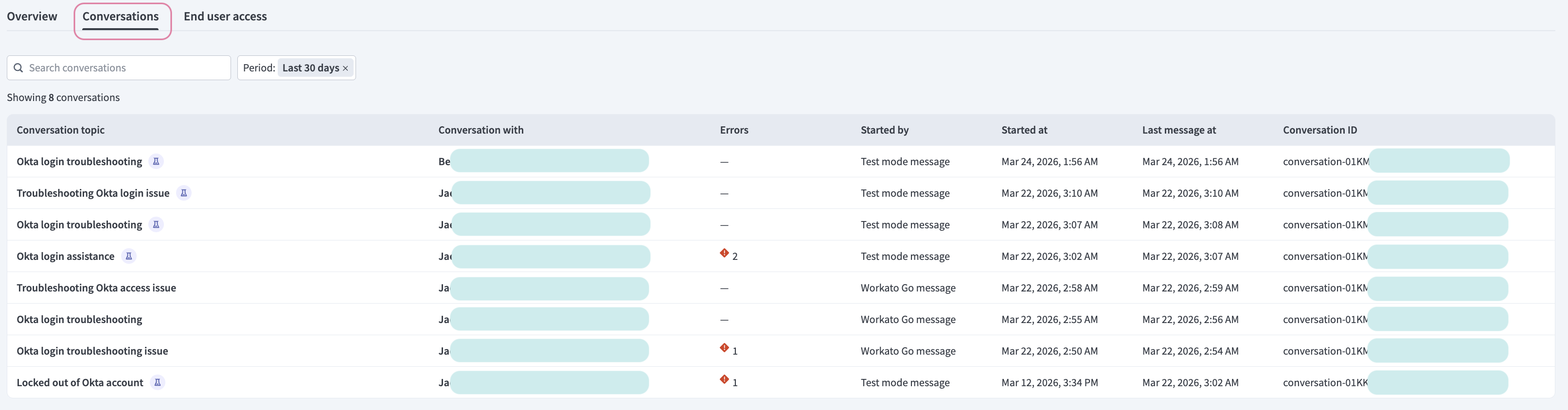 Conversations page
Click a conversation to open the Conversation details panel.
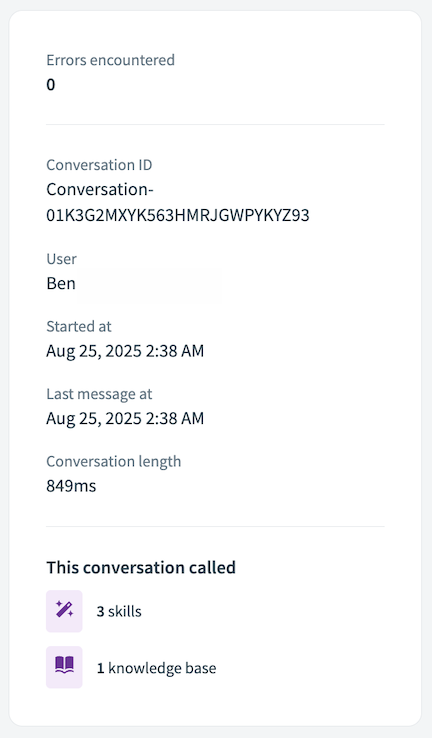 Conversation details panel
Optional. Click a genie response to view the genie Thought process panel. You can click each thought process to view additional information and switch between Input and Output.
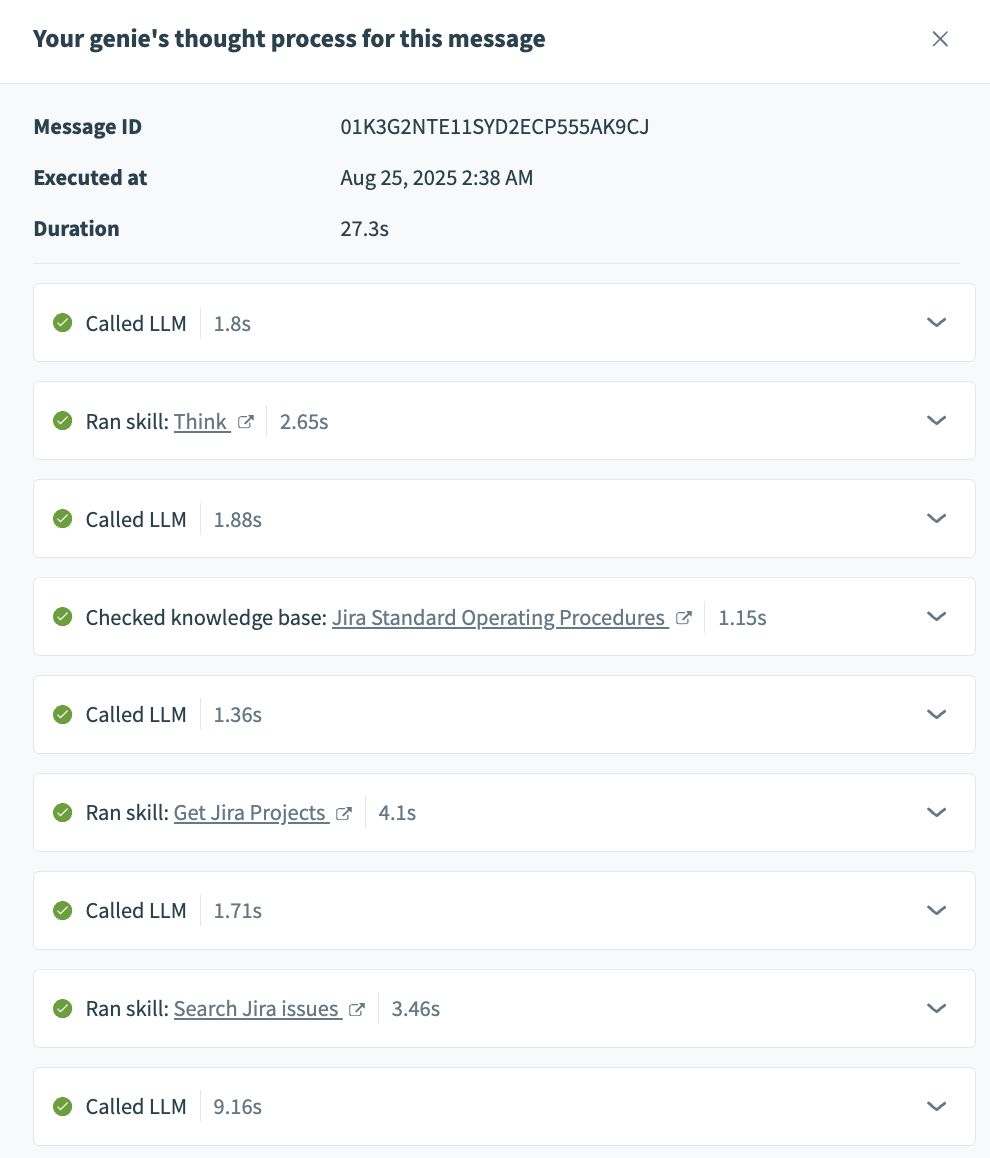 Genie thought process
# Best practices
Workato recommends the following best practices to ensure that genie conversations are tuned to meet your goals:
# Perform quality assurance testing for updated Job descriptions
Sample real conversations after you change a Job description and confirm the intended behavior change occurred and no regressions were introduced. For example, pull a sample of conversations 48-72 hours after adding a new use case, and review each conversation to confirm the genie is classifying requests correctly and invoking the right skills.
Review conversations workflow outline
- Job description change: Update the Job description and publish the changes.
- Sample conversations: Go to the Conversations page and filter for conversations from the 48-72 hours after the change.
- Review classifications: Confirm that each conversation was classified into the correct use case category and that the right skill was invoked.
- Identify regressions: Flag conversations where classification or skill invocation is incorrect as regressions and compare results to the previous Job description version.
- Resolve regressions: Update the Job description to address the regression findings and repeat the review.
# Identify gaps in knowledge base and skill performance
Workato recommends that you use the Conversations page to identify gaps in knowledge base and skill performance. Reviewing conversations at volume can reveal systematic gaps in genie capabilities that aren't visible from aggregate metrics. For example, you notice that response quality is declining on the Overview page but can't identify the cause. You can go to the Conversations page and filter for long conversations and escalations, and identify a category of questions the genie is consistently failing to answer correctly.
Identify gaps workflow outline
- Filter by outcome: Go to the Conversations page and filter the results to show conversations that ended in escalation or without the user achieving their goal.
- Filter by conversation length: Apply an additional filter for conversations with a high turn count to identify where friction is occurring.
- Identify patterns: Review the filtered conversations to identify question types and phrasings the genie handles inconsistently.
- Check Knowledge Base coverage: Check whether the relevant content exists in the Knowledge base or is missing.
- Update Skill or Knowledge base: Update the affected skill's When to Use section or add the missing content to the Knowledge base to address the gap.
# Use case examples
Refer to the following example use cases to determine how the Conversations page can be applied to your workflows:
# Compliance auditing
The Conversations page provides the primary audit evidence for organizations where AI-assisted actions require an audit trail. For example, a compliance team must verify that a genie obtained user confirmation before executing a write operation. The team opens the Conversations page, locates the relevant conversation, and reviews the full exchange to check that confirmation was obtained and the correct approval workflow was followed.
Workflow outline
- Identify conversation: The compliance team opens the Conversations page and locates the conversation associated with the action under review.
- Review exchange: The team opens the Conversation details panel and reviews the full exchange between the user and the genie.
- Verify confirmation: The team confirms that the genie requested and received user confirmation before executing the write operation.
- Check approval workflow: The team verifies that Business approvals were requested and followed for consequential operations.
- Export evidence: The team exports and submits the conversation record to auditors or regulators as evidence of AI system activity.
Last updated: 4/6/2026, 8:11:03 PM